Cloudflare Containers
defaultZero setup on the Cloudflare deployment.
Features / Agent Sandbox
Every tool call executes inside a sandbox, never on the platform
host. One SandboxExecutor
interface, ten adapters — pick a provider per environment; the
agent's code never changes.
An environment's config.sandbox_provider
selects the adapter — packages, networking, and container image are
all part of the same environment record.
Vault credentials are never mounted or exported into the sandbox. An outbound proxy matches HTTPS requests leaving the sandbox and injects the right Authorization header at the network edge.
Tools, skills, and harness logic are provider-agnostic. Swap Cloudflare Containers for Kubernetes or a bridged laptop and the agent's behavior is unchanged.
Zero setup on the Cloudflare deployment.
Pod-per-sandbox on your own cluster.
In-cluster gateway over plain HTTP.
Default-deny egress, Landlock FS.
Remote boxlite control plane, no SDK.
`oma bridge daemon` — fastest inner loop.
A WASM VM in your own tab — zero server compute.
Containers on any Docker host.
Firecracker micro-VMs, bring your key.
Managed cloud dev environments.
Native micro-VM binding.
JS eval in a fresh V8 isolate — no shell or disk.
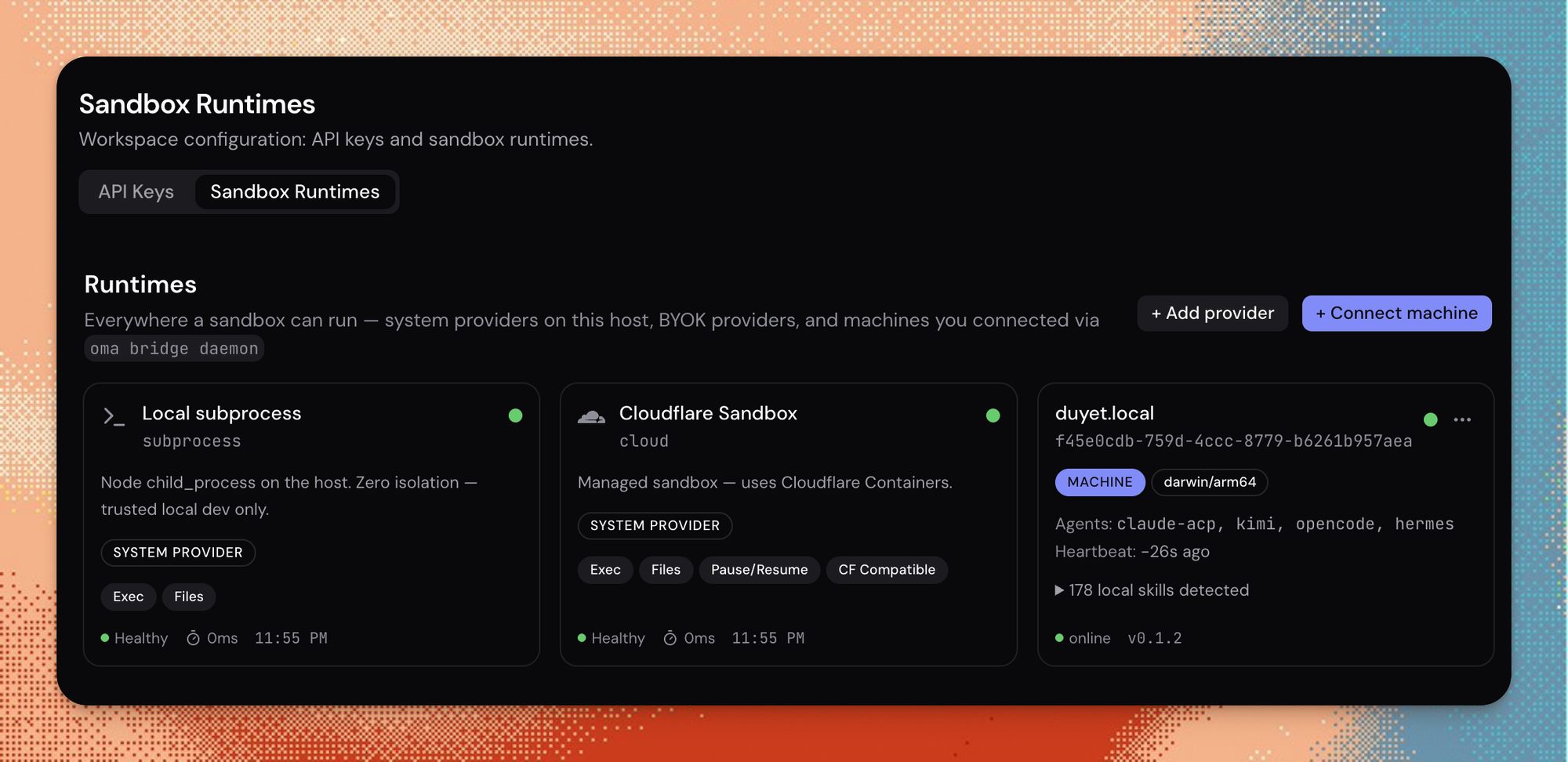
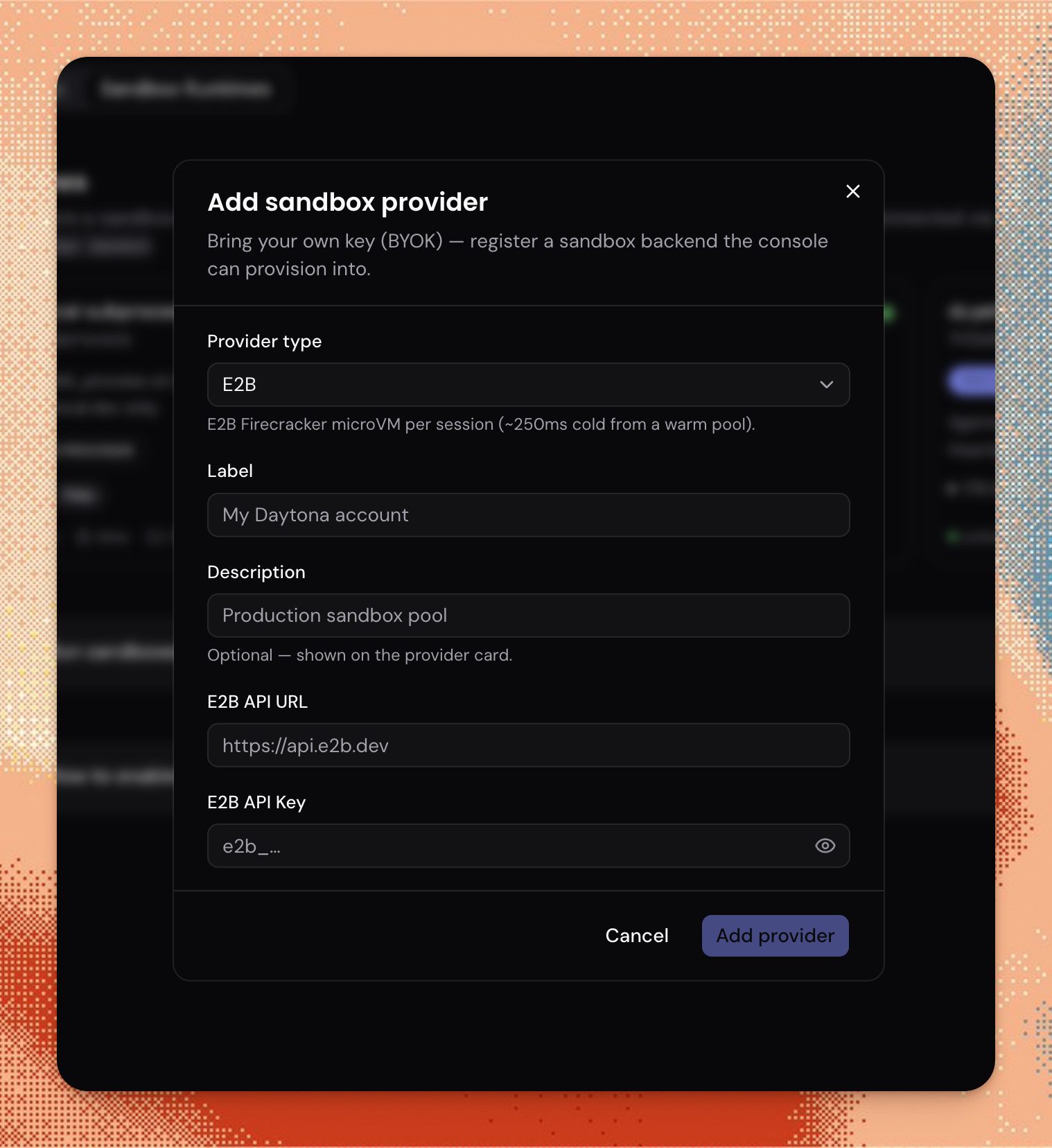
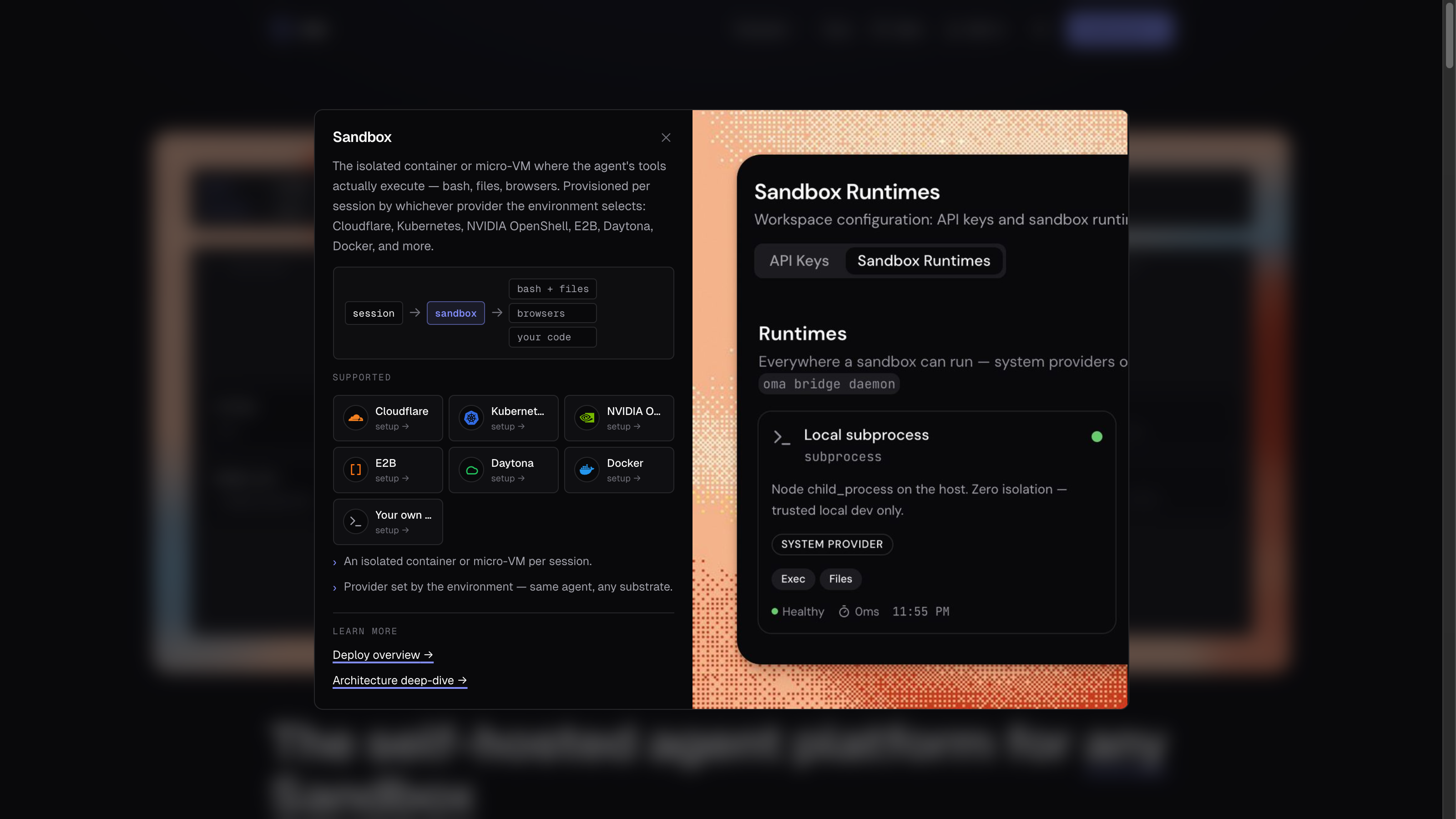
An environment is a reusable record: sandbox provider, package managers, and networking policy in one place.
{
  "name": "data-science",
  "config": {
    "sandbox_provider": "k8s-remote",
    "packages": {
      "pip": ["numpy", "pandas", "matplotlib", "scikit-learn"],
      "apt": ["ffmpeg"]
    },
    "networking": {
      "type": "limited",
      "allowed_hosts": ["api.github.com", "registry.npmjs.org"],
      "allow_mcp_servers": true,
      "allow_package_managers": true
    }
  }
}
Connecting a private cluster end-to-end (Helm charts, bridge daemon vs HTTP gateway, pod diagram) is covered on Private Kubernetes.
Cloudflare Containers work out of the box. BoxRun, k8s-remote, OpenShell, and subprocess (via the bridge relay) also work on Cloudflare — each talks to a remote control plane over plain fetch, since a Worker can't spawn processes or speak gRPC. Browser VM relays sandbox ops to a WASM Linux VM running in your own browser tab — zero server compute, opened with one click from the Console. Daytona and E2B are outbound-HTTP-only in principle but not yet wired into the Worker bundle. LiteBox, raw Kubernetes, and Docker Compose need Node builtins or a Docker socket, so they only run on the self-hosted Node runtime.
No. Vault credentials are injected by an outbound proxy that intercepts HTTPS requests leaving the sandbox and attaches the right Authorization header at the network edge. The sandbox process, the harness, and the model never see a plaintext token.
By default a delegated sub-agent thread shares the parent session's sandbox and /workspace. A callable_agents entry can set environment_id to a different environment to give that sub-agent a dedicated sandbox for the call, torn down afterward. It starts from an empty workspace and vault credential injection still works, but memory-store mounts and usage metering aren't wired for it yet.
Pausing snapshots /workspace and destroys the container — you stop paying for an idle sandbox. Resuming reprovisions the container and restores the latest snapshot. Sending a new message to a paused session resumes it implicitly on first use.
Set config.sandbox_provider on the environment (defaults to Cloudflare Containers if omitted). Every agent that references that environment runs its tools in that sandbox — no code changes to the agent itself.